

Conclusion to Occulum
All good things come to an end, or do they?

Summary
Occulum is mysterious and elegant, capturing the beauty of the unknown. Inspired by the word “occult,” it invites you to look closer. The art encourages you to discover hidden stories and new feelings every time you see it.
I wanted to create something unique and fun. For me, Occulum was never about making money. It was about exploring my passion for creating ordinals. Occulum consists of nine mini-collections, mainly because I didn’t want to limit myself to just one idea. I wanted to bring every concept I had in my head to life and share them with others.
The goal was to offer a wide range of narratives and styles to attract as many people as possible to Occulum. We have PFPs, non-PFPs, rare sats, parent-child inscriptions, low inscriptions, cursed inscriptions, and many more. I also invested a tremendous amount of time over two years to ensure the inscriptions themselves have real value and serve as the primary reason people hold them.
I believe the key to building a successful project that lasts for years is creating a strong underlying reason to hold that isn’t dependent on market conditions. If the main reason to hold is to access alpha and giveaways, then once the market turns bad, people lose all incentive to stay.
Everything for Occulum was completed in early 2025, but I wanted to wait for better market conditions to launch. Eventually, a full year passed, and I was done waiting. I didn’t want to be the only holder of something I had spent so long creating. So I decided to launch it anyway, even at a loss, and at the worst possible time. Crypto started crashing, our main marketplace Magic Eden pulled away, but I still believe that true quality will shine through and succeed regardless of the market.
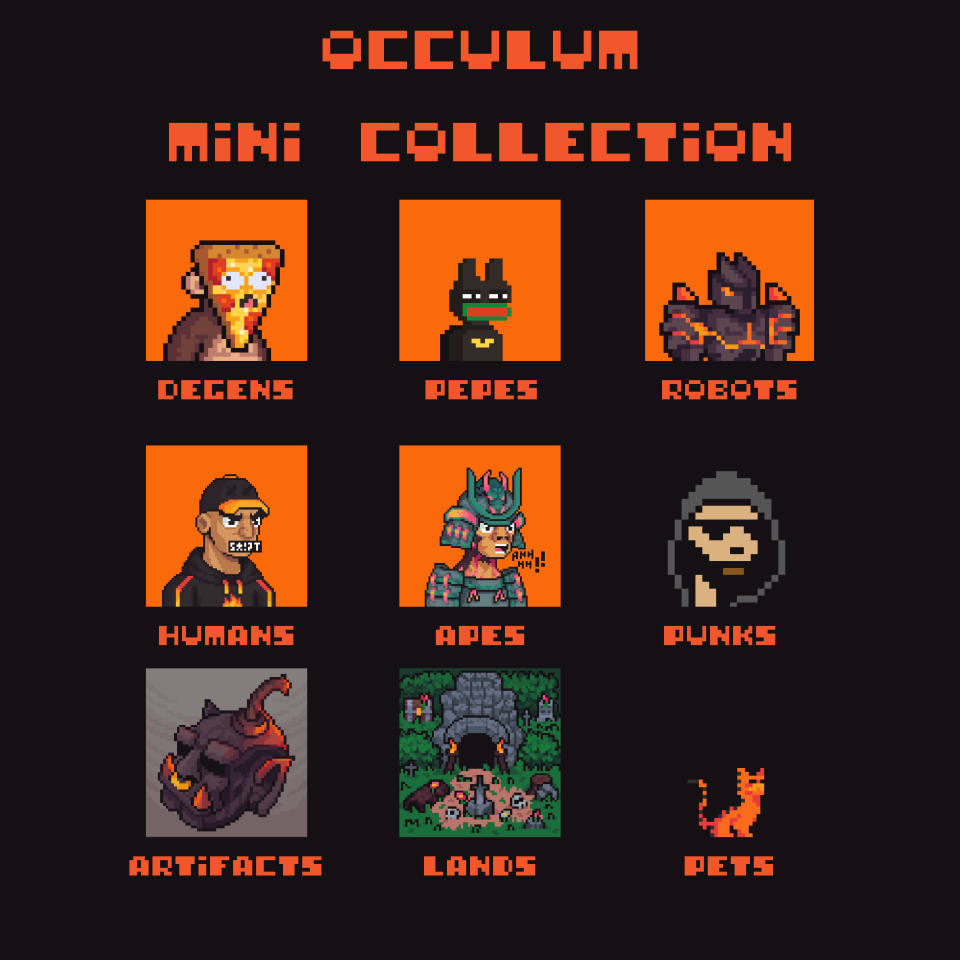
The Nine Mini-Collections:
Degens: 200 pieces (20 1/1s), pioneering rare sats with pieces inscribed on B9 sats days after OMB.
Pepes: The first collection inscribed only with rare sats (placed in the postage), consisting of 25 Pepes each on 1,000 B78 SR sats.
Robots: 100 unique 1/1s inscribed on the first 15 million satoshis in circulation (Block 9 45015x).
Humans & Apes: 222 hand-generated Humans and 222 Apes, focused on vibrant color palettes.
Punks: 20 adopted Lost Punks, mixing low and cursed sub100k inscriptions.
Artifacts: 50 1/1 parent-child pieces that broke records with 25+ different rare sat types.
Lands: 100 1/1 map pieces across 6 groups, built on multiple parents and with almost a million rare sats.
Pets: 172 cute pets across 13 designs, inscribed via parent-child.
Our First Attempt at Launching
Listing on Ord.net
At the start of 2026, Magic Eden announced it was shutting down. Leading up to the launch, I wanted to do a unique launch where I listed everything on a marketplace so people could buy whatever they liked. Since we had so many mini-collections, I thought it would be best if people could purchase their favorite pieces. Early buyers would also be rewarded with first dibs on the most desirable pieces.
I saw that lifofifo was working on releasing a new marketplace called ord.net, and I wanted to support it. So, I decided to launch my listing idea on ord.net once trading went live, encouraging people to make their first transactions on the new marketplace. We had two mint prices: 111k sats for our large mini-collections and 222k sats for our small mini-collections.
While waiting to launch Occulum, I got into the hobby of making charcoal art. One idea I had was that if we sold out, I would give holders free physical prints of my artwork. You can view my artwork here, which I inscribed.
Lowering Mint Price and Free Airdrops to Minters
The launch wasn’t going as planned, so I was forced to lower the mint price for the large mini-collections from 111k sats to 55.5k sats. Sadly, due to the lower mint price, my art print idea ended up getting scrapped.
Even with the reduced mint price, we still weren’t getting sales. So I decided to remove 100 pieces from the launch and evenly split them among the minters. Anyone who had bought from the first launch received a free mint airdropped to them.
To prevent people from instantly dumping their free mints and to give us a better chance of minting out the rest of the collection, I airdropped them as time-locked pieces. This meant people still owned what I sent them, but they had to wait until block 1,000,000 to unlock them (about a one-year wait).
I also decided to give out free pieces of my charcoal art inscriptions to anyone who bought 5 or more. After lowering the mint price and selling for 7 days, we had only sold around 100 pieces while giving away another 100 through incentives. We also airdropped 273 pieces (not time-locked, TX 1, TX 2) to our old OG holders for free. We still had more than 300 left, and I didn’t want to stop trying until I knew I couldn’t.
OTC Desk + Referral System
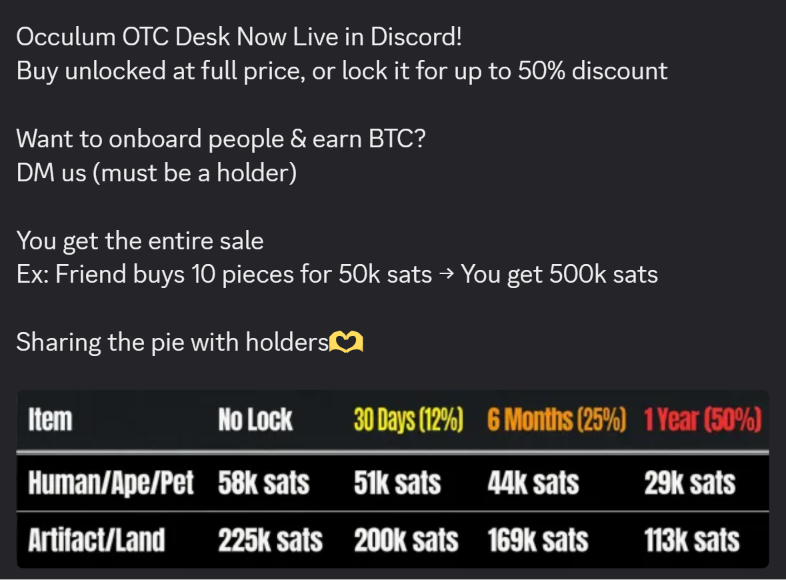
I then removed all our listings on ord.net and decided to move all new sales to OTC. Instead of selling OTC at the same mint prices, I thought it would be cool to offer discounts to people who locked up what they bought. That way, I could reward true collectors who wouldn’t have sold anyway but would gladly lock up their pieces for one year to get a 50% discount. You can view all our time-locks here.
I then decided to do something that had never been done before. At this point, I didn’t care about receiving BTC from the sales; I just wanted to distribute Occulum without simply giving it all away for free. So instead of me slowly onboarding people into Occulum, I shifted that responsibility to our holders, allowing them to reap the benefits. If they onboarded a friend who bought 5 pieces at 100k sats each, the referrer would receive the full 500k sats instead of the project.
One of our holders came up with a creative way to bring people into Occulum by giving away a free Bitcoin home miner to anyone who bought OTC. I thought the idea would perform well, but we only sold around 30 pieces OTC and ended up giving out over 500k sats to referrers.
Our Second Attempt
The Idea
I saw that ord.net was launching its own launchpad called the Foundry. At first, my original plan was to do a slow mint on the launchpad, where people would receive a random mint instead of choosing what they wanted.
At the time, I was very active in the Parasite mining community, and we were struggling to mine the pool’s third block. So I connected the dots and thought, why don’t I launch on this new launchpad and help out the Parasite pool at the same time?
The plan was to use all funds collected from the launch to rent Bitcoin mining hashpower for Parasite. I included a large portion of my small mini-collections in the mint, giving people a 33% chance of minting a land or artifact. I also decided to randomly refund 1 out of every 10 mints using my own money. If we sold out, we would have had a 7.5% chance of hitting a block, and if we did, I would have sent 200k sats for every mint.
Parasite Pool is also unique because it has a rewards dispensary for hitting certain Bitcoin difficulty levels. More details on Parasite in the next section.
Overall, this was a one-of-a-kind mint. There was so much more going on; we could potentially mine a Bitcoin block through Parasite. It made mining Bitcoin more fun because even if you didn’t win anything, you still received a cool ordinal with your mint. The mint funds, which normally would have been held by the project, were instead used to do something genuinely cool.
What Is Parasite?
Parasite Pool is a decentralized, zero-fee Bitcoin mining pool open to all, designed to disrupt corporate mining monopolies by empowering small-scale home miners. Unlike traditional pools, it charges no fees and enforces an ultra-low 8k sat payout threshold, making it highly accessible and economically viable for users operating small rigs.
The pool utilizes custom coinbase logic and the Lightning Network to deliver near-instant, fee-free payouts, bypassing standard block maturity rules and complex channel management. When the pool successfully mines a block, the specific finder is awarded exactly 1 BTC, while the remaining block subsidy and transaction fees are distributed among all other pool participants based on their contributed total work.
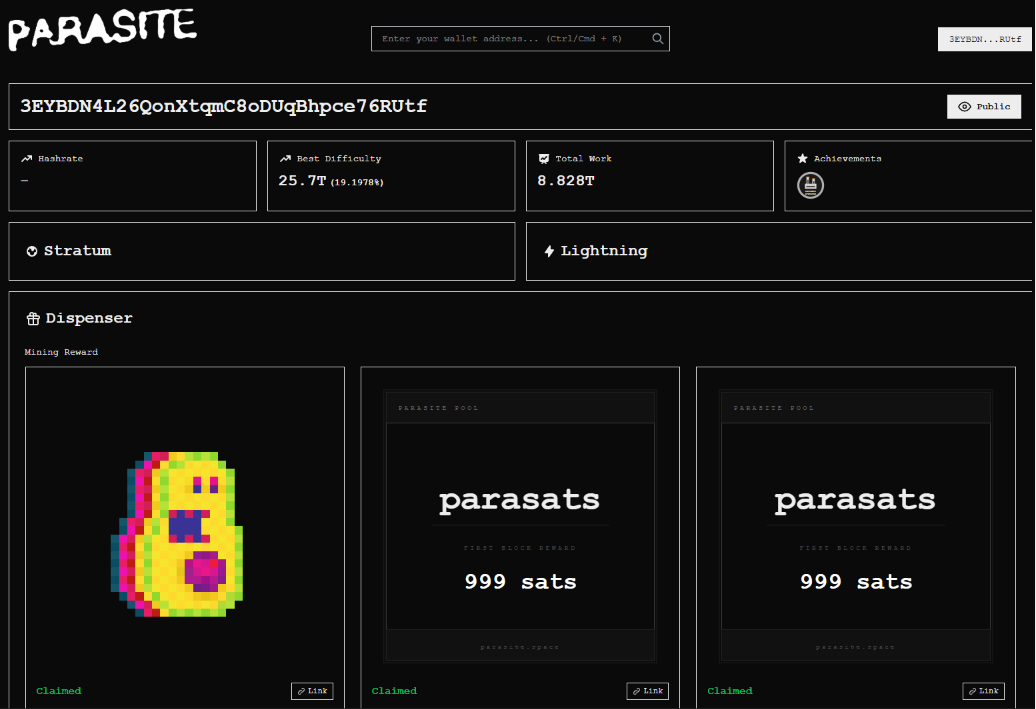
To further incentivize and gamify the experience, Parasite Pool also features a Dispenser rewards system. Through this system, miners who hit certain Bitcoin difficulty can unlock rewards, such as parasats, Bravocados, and more, adding a fun, community-driven layer to the mining process.
Why do this?
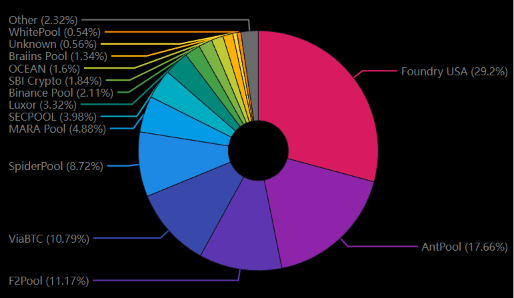
Currently, more than 50% of the Bitcoin network is run by just three mining pool entities. Bitcoin is in a vulnerable position where these three parties could significantly impact the network.
We wanted to support a newer, more innovative mining pool built for small home miners rather than large corporations. Renting hash rate and directing it to mine blocks for Parasite helps legitimize the pool and contributes to its growth. Although the main goal of Parasite is to onboard home miners to Bitcoin, I believe the initiative we’ve undertaken is positive for the ecosystem, and others should consider joining as well.
As an Ordinals collection, this is especially important. With so few mining participants, it helps prevent proposals like BIP-110, which would restrict the ability to post arbitrary data on Bitcoin, from passing. Many view BIP-110 as suppressing Bitcoin’s permissionless nature and freedom to use the blockchain for data storage.
The Results
We rented 1 EH/s for 10.35 hours, using 100% of the mint funds (0.22 BTC). Unfortunately, we got quite unlucky with the rent. For most of the rental period, we didn’t hit any major Bitcoin difficulty until the very last block, when we finally landed a massive 25.7T hit.
Still, we managed to hit above 1T four separate times. This earned us 3,996 Parasats, the special sats from the very first block Parasite mined. We also hit above 10T once, which gave us a tasty Bitcoin Bravocado. At the time of writing, the only way to get a Bitcoin Bravocado (a shroom parent-child collection) is by hitting 10T. On average, it costs around 0.25 BTC in rentals to hit 10T, making this an exclusive and valuable collection.
You can view the rewards sent out here (Including our 25 refunds, TX 1, TX 2).
The Giveaway
I decided to run a poll to determine how to give away this Bravocado. We provided four options: a normal raffle, a raffle exclusive to those who time-locked their mints, selling it to buy OMBs for a raffle, or selling it to raffle off the BTC to minters. For the raffle mechanics, we tracked all 258 mints from the time of selling out. Anyone who listed or sold their mint was removed from the draw. 1 mint = 1 raffle ticket.
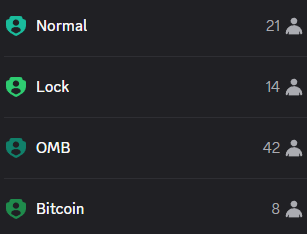
After giving holders 72 hours to vote, we had a total of 85 voters. OMB won with 42 votes. We then sold our Bravocado for 0.05 BTC and used the funds to purchase the three OMBs below.
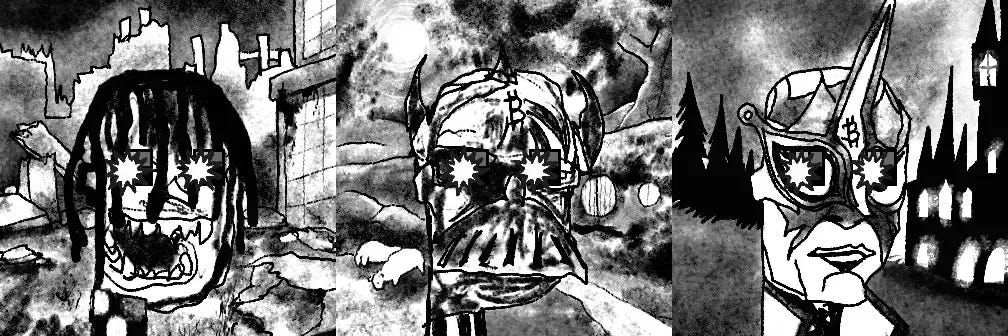
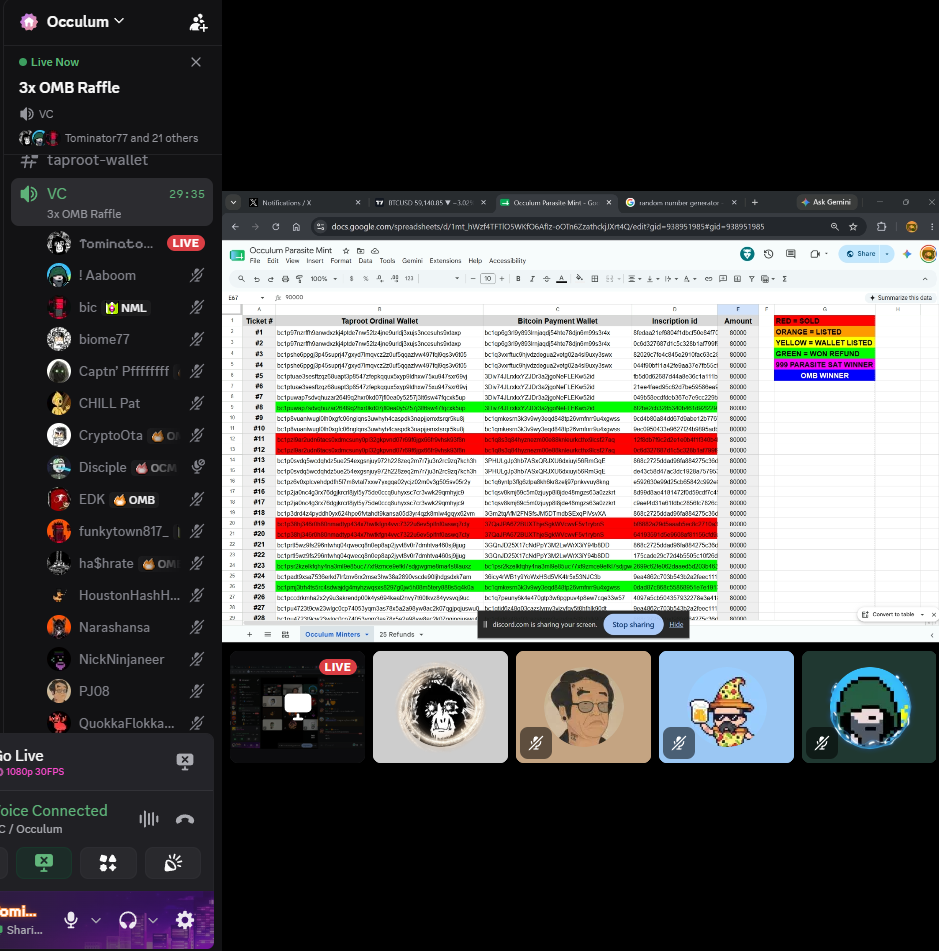
I then went live in VC on June 25, 2026, at 11:00 AM to raffle out the three OMBs. I used a random number generator to pick each winner. It was a really cool moment being able to give these OMBs away, and it’s one I’ll never forget (OMB sends: TX 1, TX 2, TX 3).
A Look Back
The journey to fully distribute Occulum has surely been an interesting one. I learned a lot about human psychology along the way. When people have too many options and see too many incentives, it becomes too complex to understand, and they often start questioning things: Why is this project lowering the mint price? Why do they have so many collections? Why isn’t it launching on a traditional launchpad? Etc.
At the start, I mainly focused on explaining each of our mini-collections and offering too many incentives. That approach flipped when I changed the mint into something bigger and more meaningful. It now had a clear goal and a small chance of big rewards. I incorporated the Parasite mining idea to add more fun to the minting experience. Usually, you mint something, and that’s it, but with Parasite, you can hit a block and get rewarded with Bitcoin, or hit ordinals from their dispensary like a Bravocado. We’re also helping push the decentralization of Bitcoin mining by supporting a smaller pool like Parasite.
People got a nice dopamine rush from minting, knowing there was a chance to win a refund, a chance to mint a rare piece, a chance we’d hit a block, or a chance we’d hit a Bravocado and give it away. From that initial attention, I was able to shift the conversation toward the art and the project itself. We went from “Hey, can we hit a block?” to “What is this collection? I actually really like this and what you did.”
I think it’s great to do something truly unique and creative, but those kinds of projects often work better after the launch, once people have the time to look deeper.
The process of creating Occulum was a lot of fun, but spreading the word and selling out was just as stimulating.
Some advice for anyone planning to create an ordinal collection in the future: Be your true self and don’t give up. Being authentic helps you stand out from everyone else, and not giving up gives you enough time for people to actually recognize what you’re doing.
What is Next?
At the time of writing, just 10◇910010. Whatever comes next will be a surprise and something I truly loved working on.
This was written from the perspective of Tominator/Nick. Shoutout to our artist, Jazz, and to Danter, who helped inscribe Occulum.
man. you’re a strong soldier.
Thanks